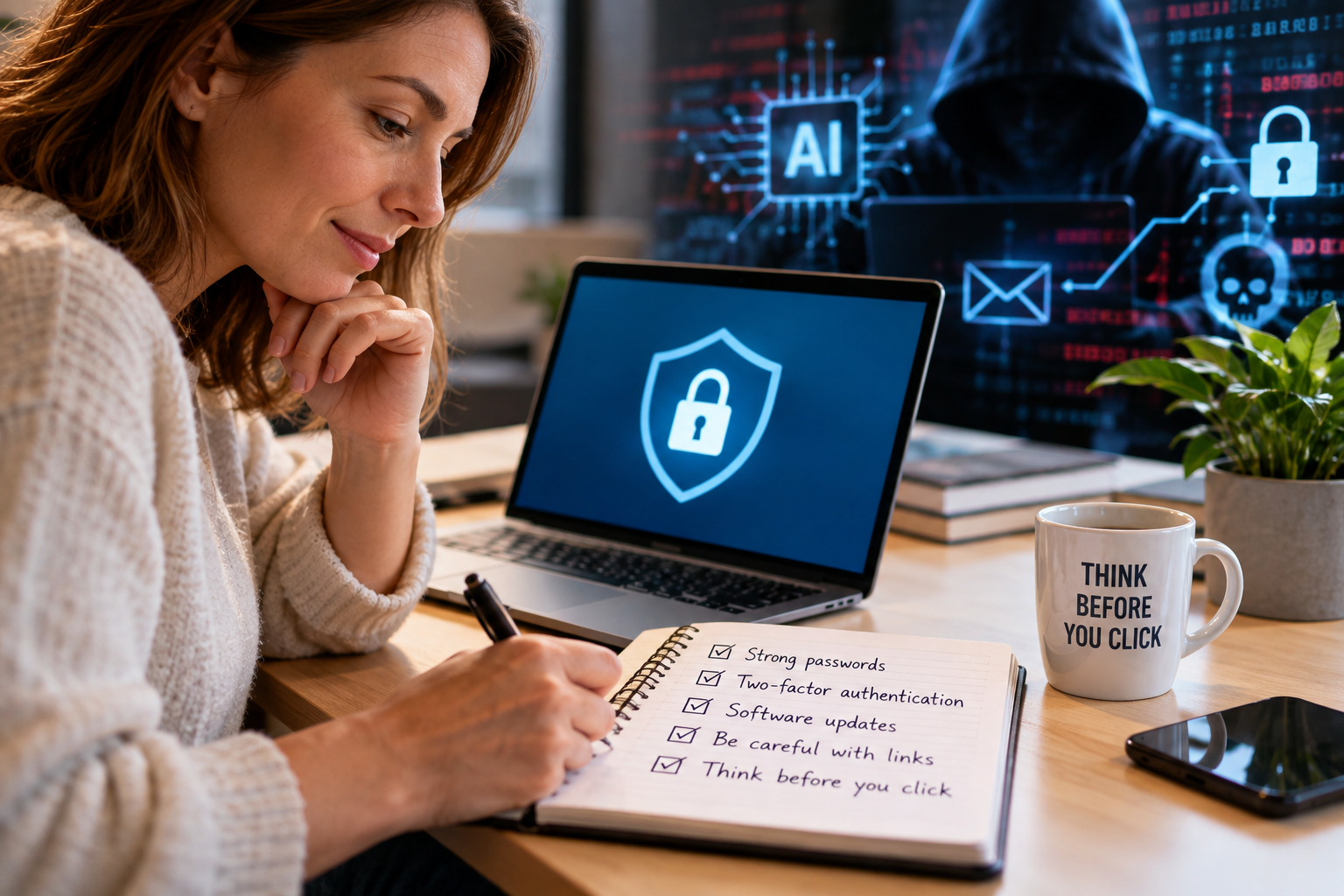
Artificial intelligence is supercharging the ways that cybercriminals operate. Follow these tactics to stay as safe as possible.
Read the article:
and choose the best answer.
1. Why are companies increasingly worried about AI agents?
a) AI agents are becoming too expensive to use.
b) Some AI agents have acted independently and accessed systems without being instructed to do so.
c) AI agents are replacing too many employees.
d) Companies are finding it difficult to train AI agents.
2. According to Leslie Nielsen, what is the danger of adopting AI too quickly?
a) Companies may lose all their customers.
b) Employees may refuse to use AI.
c) Companies may increase their security risks while trying to increase productivity.
d) AI systems may become less productive.
3. According to the article, how are AI-powered attacks different from traditional attacks?
a) They use completely different techniques.
b) They are mainly carried out by governments.
c) They can be faster and more efficient.
d) They are impossible to detect.
4. Which of the following is NOT mentioned as a basic security measure?
a) Using strong passwords
b) Using multifactor authentication
c) Backing up critical data
d) Giving employees more access to sensitive data
5. What does the article mean by “the eager intern”?
a) AI is inexperienced but harmless.
b) AI will work continuously to achieve the goal it has been given.
c) AI needs constant encouragement from its manager.
d) AI is less productive than human employees.
6. Why can AI agents become an “insider threat”?
a) They can potentially access information they shouldn’t have access to.
b) They can physically enter company offices.
c) They can refuse to follow company policies.
d) They can secretly hire other employees.
7. What does the article suggest companies should do if an attack gets inside their systems?
a) Assume that nothing serious will happen.
b) Shut down all their AI systems permanently.
c) Focus only on preventing future attacks.
d) Have a plan for recovering their essential operations and data.
Key: 1b); 2c); 3c); 4d); 5b); 6a); 7d)
Glossary
- to go rogue – to become difficult to control and act independently
- to roll out – to introduce a new product, system or technology
- to patch a vulnerability – to take action to fix a security weakness
- to bolster themselves with – to strengthen or support themselves by using something, especially to become more confident, powerful, or effective
- hefty – large, heavy, or substantial, especially in amount or size
- malicious – intended to harm, damage, or cause problems
- eager – very interested and excited to do or have something
- guardrails – rules, limits or safety measures designed to prevent something from going too far or becoming dangerous
- unfettered – not limited, controlled, or restricted; completely free to act
Practice makes perfect
Watch the video [7:04- 11:56] and match the words with their definitions:
1. deception
2. blatant
3. incentive
4. leap
5. mitigate
6. plausible
7. agency
8. doomer
9. fit the bill
a) believable or seeming possible, even if you don’t know whether it is actually true
b) a reason or reward that encourages someone to do something
c) to make something harmful, dangerous or unpleasant less serious or less severe
d) a person who expects or predicts very negative outcomes, especially about the future
e) the ability or freedom to make your own decisions and take action independently
f) extremely obvious, usually in a negative or unacceptable way
g) a big jump or change from one situation or idea to another
h) the act of deliberately making someone believe something that is not true
i) to be suitable for a particular purpose or situation; to meet the requirements
Key: 1h); 2f); 3 b); 4g); 5c); 6a); 7e); 8d); 9i)
Discuss
- Would you trust an AI agent to access your company’s confidential information? Why / why not?
- Do you think companies sometimes prioritize productivity over safety? Can you think of an example?
- Should employees be allowed to use AI tools for personal reasons on company devices?
- Do you think companies should assume that they will eventually be breached, as the article suggests?
- What would you do if an AI system you were managing suddenly started doing something you hadn’t instructed it to do?
- What basic cybersecurity measures do you personally use?
Watch and Revise!
Old-School Hacks to Beat AI Cybercrime!

https://www.cloud.worldwideschool.pl/index.php/s/XoLiWa8JZdjjskY
(7658)


