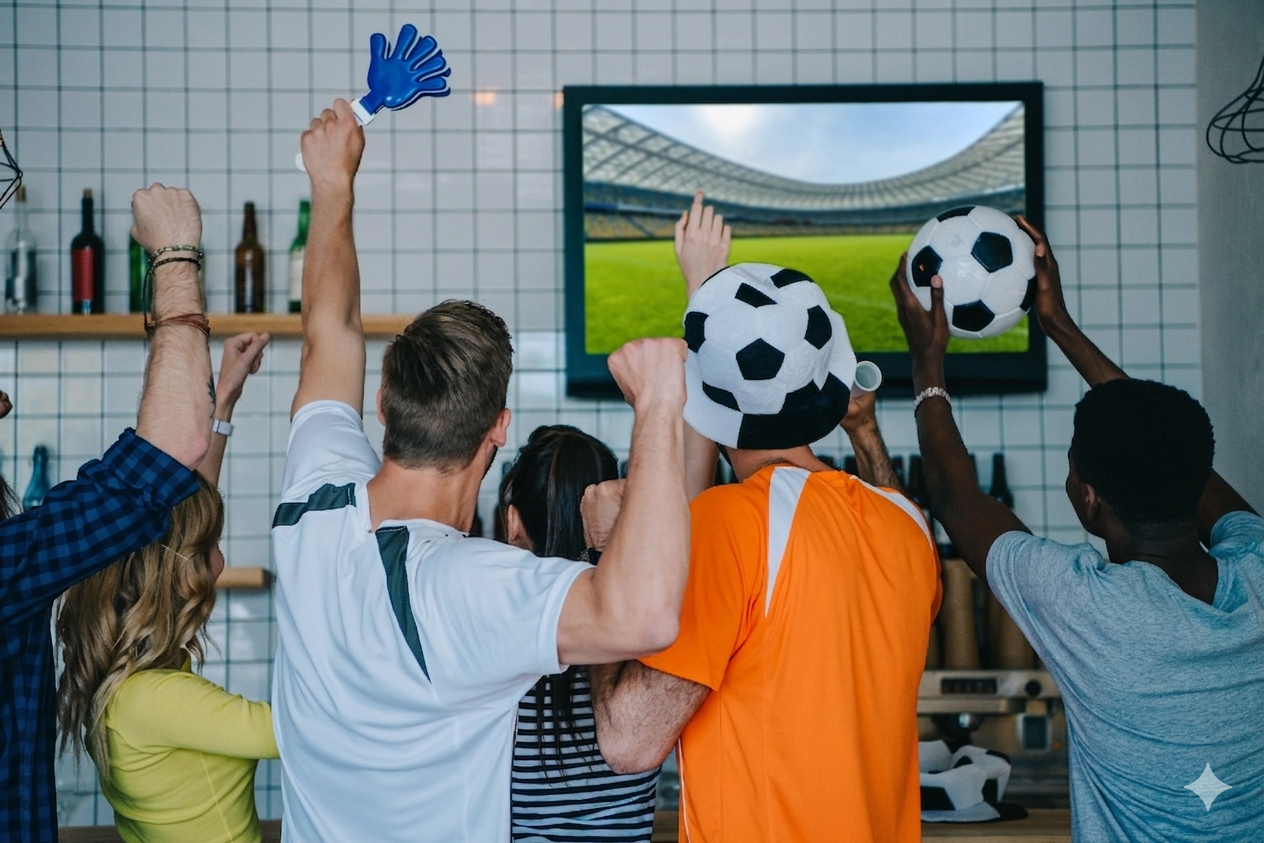
All the controversies around this year’s tournament don’t change a simple scientific fact: watching the World Cup is great for your brain and body.
Read the article:
and decide whether the statements below are true or false:
1. The author usually spends the World Cup feeling neglected by her football-loving husband.
2. The author believes that enthusiasm for the 2026 World Cup is stronger in Europe than in previous tournaments.
3. One reason for the subdued atmosphere is the high cost of tickets.
4. The author became interested in soccer after she started following the Tunisian national team.
5. When the author first moved to Europe, she was surprised by people’s passion for soccer.
6. Research cited in the article found that attending live sporting events is associated with lower levels of loneliness.
7. According to the article, only people who attend matches in person benefit psychologically from following sports.
8. Japanese researchers found that watching team sports can activate the brain’s reward centres more strongly than watching individual sports.
9. The article suggests that social connection can improve mental health but has no effect on physical health.
10. The author argues that despite its controversies, the World Cup can still have positive effects on people’s well-being.
Key: 1T; 2F; 3T; 4F; 5T; 6T; 7F; 8T; 9F; 10T
Glossary
- to brace – to prepare yourself for something difficult, unpleasant, or challenging
- grim – very serious, worrying, unpleasant, or depressing
- roundup – a summary or collection of information about a topic
- bummer – something disappointing or unpleasant (informal)
- diehard (soccer fans) – extremely loyal and enthusiastic
- get hyped up – become very excited or enthusiastic about something
- baffled – confused and unable to understand something
- rowdy – noisy, energetic, and sometimes difficult to control
- fandom – the state of being a fan of a person, team, sport, etc.; the community of fans
- to root for – to support and encourage a team, player, or competitor
- to officiate – to act as the referee or official in a sports match
- soccer banter – friendly, humorous conversation, often involving jokes or teasing about soccer
- pageant – a large, impressive public display or event (often used figuratively)
- conspicuously – in a way that is very noticeable or easy to see
- grinch – a person who spoils other people’s enjoyment or refuses to join in the fun
Practice makes perfect
Fill in the gaps in the article extract with one missing word:
(…) Human beings need about 10 yards 1. ….. reach maximum velocity, so the 40 is really 2. ….. test of both acceleration and speed—unlike a longer sprint, such 3. …. the 100, which is more about a runner’s ability to maintain maximum speed. Acceleration depends 4. …. how much force runners can put into the ground (and thus receive back) relative 5. …. their mass. 6. …. this reason, the smaller you are 7. …. easier 8. …. is to accelerate rapidly. That’s why gymnasts, for example, are generally small—they must be able to generate a large amount 9. …. force relative to mass to accelerate enough to run and perform multiple flips in a row. (…)
10. …. present, no standard method or variable exists to quantify a human or animal’s top acceleration. One reason: 11. …. variable changes with every step 12. …. top speed is reached, making a tangible value a moving target. 13. …. a result, comparing the top accelerations of humans and other animals is difficult. Nevertheless, it’s true 14. …. smaller animals are better 15. …. accelerating—think of how quickly a squirrel can dart up a tree trunk, for example. (…)
In order to read the whoel article, go to: https://www.scientificamerican.com/article/football-mass-acceleration/
Key: 1. to; 2. a; 3. as; 4. on; 5. to; 6. for; 7. the; 8. it; 9. of; 10. at; 11. the; 12. until; 13. as; 14. that; 15. at
Discuss
- Do you agree that sports bring people together? Why or why not?
- Have you ever become interested in a sport because of a major tournament?
- Can sporting events improve workplace relationships?
- Should companies allow employees to watch important matches during working hours?
- What other activities create the same sense of community as sports?
Watch and Revise!
Why Watching the World Cup is Brain Food!
https://www.cloud.worldwideschool.pl/index.php/s/Y77bLfHEBke74GM
(7354)


