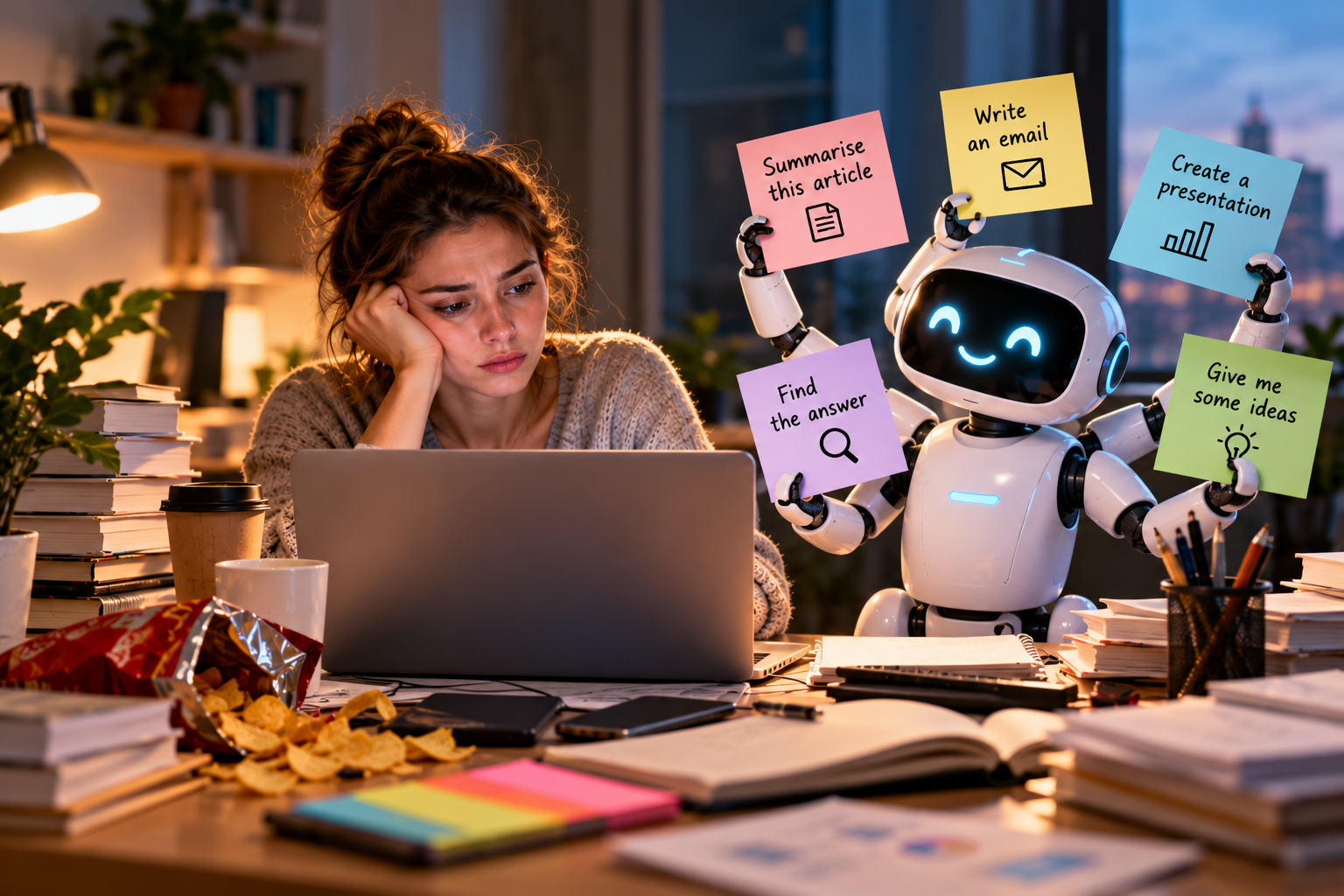
Don’t want AI to rot your brain and erode your core skills? According to new research, making this simple shift in how you prompt AI turns it from a crutch into a cognitive booster.
Read the article:
and decide if the sentences below are true or false:
1. The article suggests that using AI to make every task easier is anything but the best approach.
2. Asking AI to challenge your assumptions may temporarily increase your workload.
3. The operations professional immediately accepted AI’s suggestions without further investigation.
4. According to the article, AI-induced cognitive decline is unavoidable.
5. Leaders can influence how employees use AI by changing the way they encourage experimentation.
6. The author recommends treating AI as a critical thinking partner rather than simply a tool that agrees with you.
Key: 1T; 2T; 3F; 4F; 5T; 6T
Glossary
- crutch – something that provides help and support and that you depend on, often too much
- to hand off – to transfer a task, responsibility or piece of work to another person or system, often so that they can take over
- to ideate – to generate, develop or come up with ideas, especially as part of a creative or problem-solving process
- atrophy – the gradual weakening or deterioration of something because it is not being used or exercised
- to be toast (informal) – to be likely to be unsuccessful, destroyed, or dead
- to square – to reconcile two apparently conflicting facts, ideas or beliefs; to find a way to make them logically compatible
- irreconcilable – impossible or very difficult to make compatible or bring into agreement
- to slap – to put something together quickly and with little care or preparation, often just to get it finished
- to sap – to gradually weaken or drain something, such as someone’s energy, confidence, strength or intelligence
- to poke holes in something – to find mistakes or problems in a plan or in what someone has said
- tweak – a small adjustment or improvement made to something; to make a small change to improve the way something works
- sycophantic – excessively flattering or agreeing with someone, usually to gain their approval or favour rather than expressing an honest opinion
Practice makes perfect
Read the article:
https://www.inc.com/jessica-stillman/5-ways-you-re-making-yourself-dumber.
and choose the correct answer (a, b or c) to complete each sentence.
1. Eating too much junk food may ………. your ability to concentrate and think clearly.
a) enhance
b) impair
c) venture
2. After several nights of poor sleep, she found it difficult to ………. even the simplest information.
a) retain
b) claim
c) shrink
3. Employees who believe they know everything about a subject may become ………. and stop questioning their assumptions.
a) complacent
b) dependent
c) inaccurate
4. Trying to answer emails, attend meetings and prepare a report at the same time can ………. your concentration.
a) contribute
b) retrieve
c) disrupt
5. People sometimes ………. their own knowledge and believe they understand a subject better than they actually do.
a) overestimate
b) deteriorate
c) multitask
6. Regularly relying on Google for every answer can make us overly ………. on the internet.
a) flexible
b) dependent
c) accurate
7. A lack of sleep can have a(n) ………. effect on our memory and thinking skills.
a) instant
b) clueless
c) extremely large
8. People who multitask frequently may find it harder to ………. their attention on one task.
a) claim
b) focus
c) lower
9. When asked about the topic, he confidently ………. that he knew all the relevant facts, although he hadn’t checked them.
a) claimed
b) shrank
c) turned in
Key: 1b); 2a); 3a); 4c; 5a); 6b); 7c); 8b); 9a)
Discuss
- Do you use AI tools in your everyday life or at work? Which tasks do you tend to hand off to AI, and which do you prefer to handle yourself?
- The first article suggests that we should ask AI to challenge our ideas rather than simply make our work easier. Would you be comfortable asking AI to poke holes in your arguments? Why or why not?
- Have you ever accepted an answer from AI or Google without checking whether it was accurate? What could be the consequences of doing this at work?
- Do you think relying on AI to write emails, prepare presentations or generate ideas could eventually weaken our own skills? Why / Why not?
- Which approach do you think is more useful when solving a difficult problem: asking AI to suggest a solution or asking it to identify the weaknesses in your own solution?
- Some people believe that employees who don’t learn to use AI will fall behs us more knowledgeable or more dependent on technology?
Watch and Revise!
The One AI Habit That Helps You Think Better
https://www.cloud.worldwideschool.pl/index.php/s/BFDqT297CiXRjDH
(7793)


